
Gallery 98 is now a stand-alone online store offering a full range of vintage art ephemera from the 1960s through the first years of the 21st Century. However, when the gallery first went online about fifteen years ago, it was intended to offer only works connected to the website: 98 Bowery, 1969–89: View from the Top Floor by Marc H Miller.
In the 1970s and 80s, Miller was an artist, curator and writer closely involved with the downtown music and art scene. His autobiographical site 98 Bowery, named after the building he lived in for twenty years, provides a first-person perspective of a dynamic era when the East Village and the Lower East Side gave rise to new cultural directions that had worldwide impact.
Particularly prominent on the 98 Bowery site, are online versions of three out-of-print publications that connect to the site’s broader contents. The catalogue for the exhibition Lives (1975) captures the moment when photographers and performance artists turned away from “art about art” to embrace “art about life.” The exhibition catalogue for Punk Art (1978), presents the period’s fusion of nightlife, music, film, fashion and art. The third publication, ABC No Rio Dinero; The Story of a Lower East Side Art Gallery (1985), tracks the rise of socially aware art as it emerged in conjunction with the artists group Collaborative Projects Inc. (COLAB). Together, these three online publications provide a full history of the alternative art movements that invigorated the downtown art scene in the late 1970s and early 80s.
98 Bowery: View from the Top Floor, 1969 – 1989
Lives, Fine Arts Building, November 29 – December 20, 1975
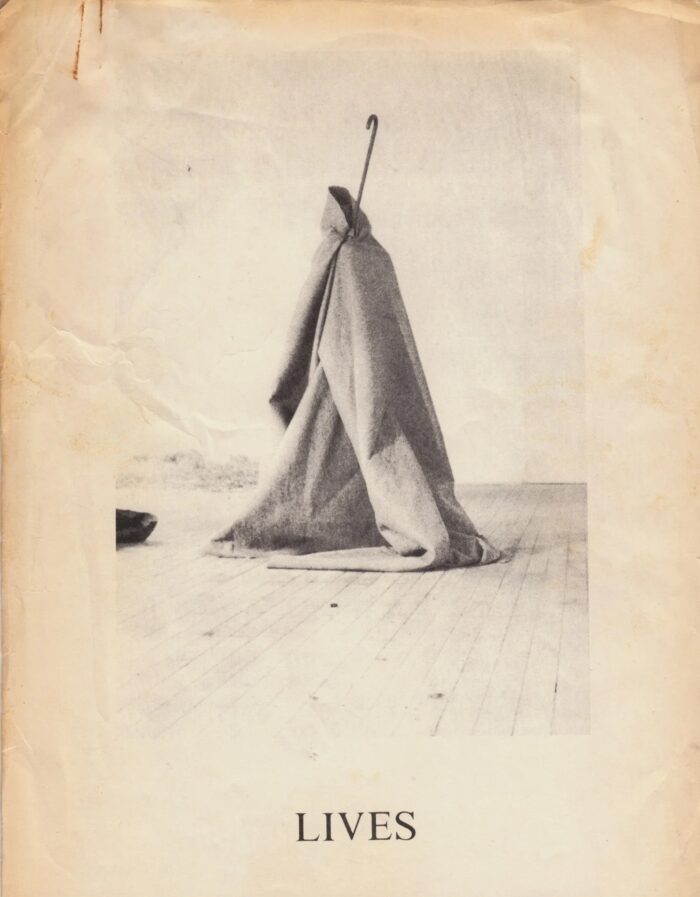
Lives, exhibition and catalogue by Jeffrey Deitch, catalogue cover by Joseph Beuys, Fine Arts Building, November 29 – December 20, 1975. Size: 8.5 x 11 inches
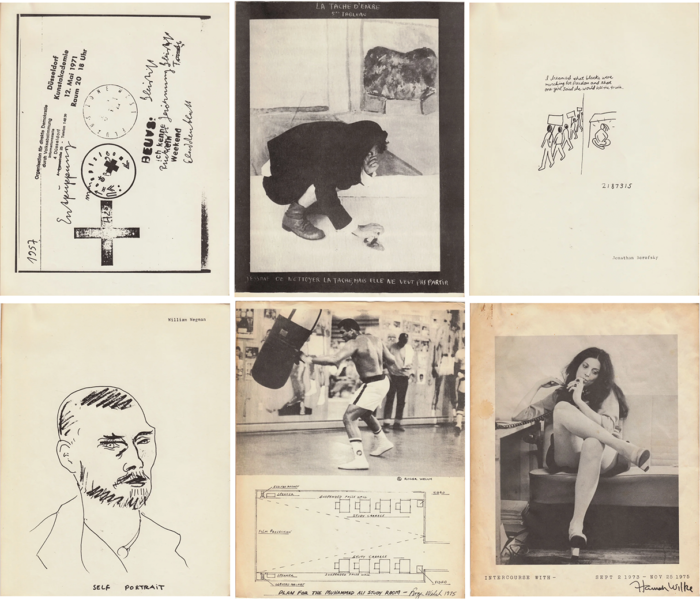
Artist pages from Lives catalogue. Top row: Joseph Beuys, Christian Boltanski, Jonathan Borofsky. Bottom row: William Wegman, Roger Welch, Hannah Wilke
Jeffrey Deitch, now a famous gallerist, was only 23 when he curated the exhibition Lives at the Fine Arts Building (NYC) in 1975. Subtitled “Artists Who Deal With Peoples’ Lives (Including Their Own) As The Subject And/Or The Medium Of Their Work,” the exhibition showed how art evolved away from abstraction and didacticism, and began embracing real-life issues. In keeping with the do-it-yourself spirit of the early ’70s, Deitch produced a photocopy catalog that includes an insightful text along with pages created by each of the artists in the show.
Punk Art, Washington Project for the Arts, May 15 – June 10, 1978
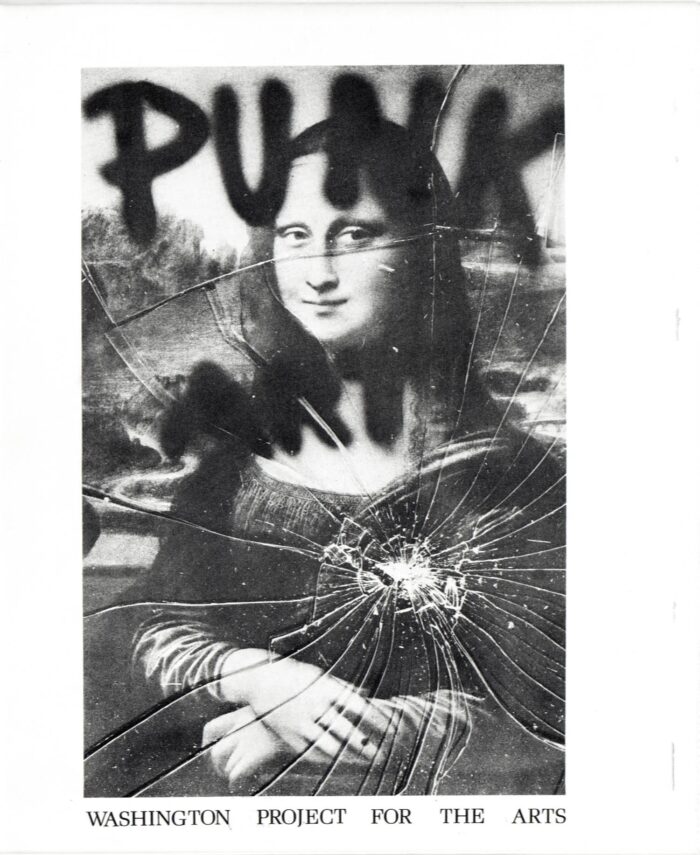
Punk Art, exhibition and catalogue organized by Marc H Miller, Bettie Ringma, Alice Denney, catalouge cover “Smashed Mona” by Miller, Ringma, and Curt Hoppe, Washington Project for the Arts, 27-Page Catalogue, 1978. Size: 24 x 11.5 inches
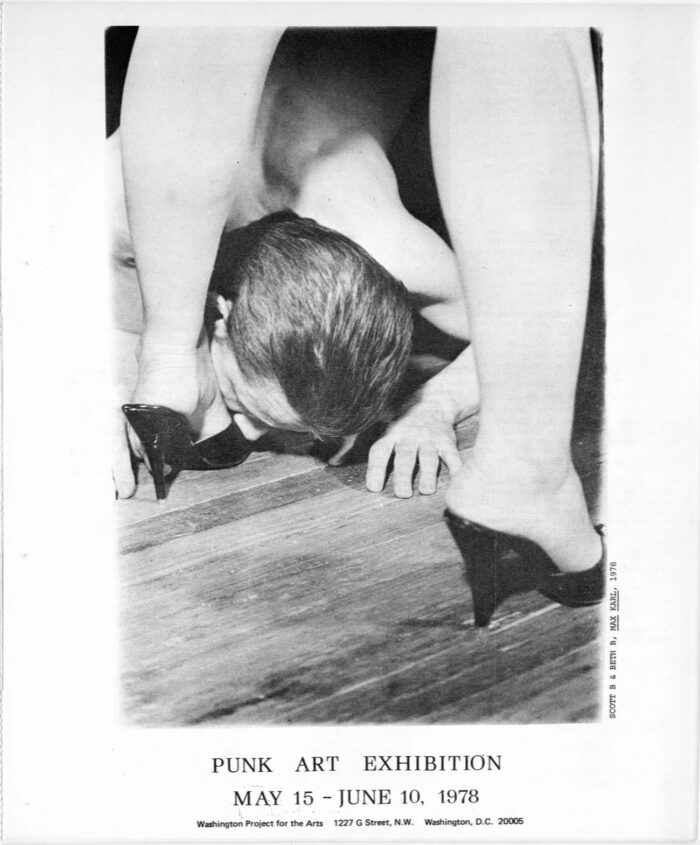
Punk Art, back cover “Max Karl” by Scott B & Beth B, 1978
98 Bowery was located just a few blocks south of the club CBGB, where a new music and counter-culture emerged in the late 1970s. The exhibition Punk Art was conceived when Alice Denney, the founder of the Washington Project for the Arts, asked Bettie Ringma and Marc H Miller to curate a show that explored the newest art in New York. The title Punk Art was partially branding, but it was also legitimate in that the visual artists in the show all frequented CBGB and were involved with Punk. The show had wide impact, and the term Punk Art continues to be used today. Marie Arleth Skov’s recent book Punk Art History (2023) devotes a full chapter to the exhibition.
ABC No Rio Dinero: The Story of a Lower East Side Art Gallery, Published by Collaborative Projects Inc, 1985
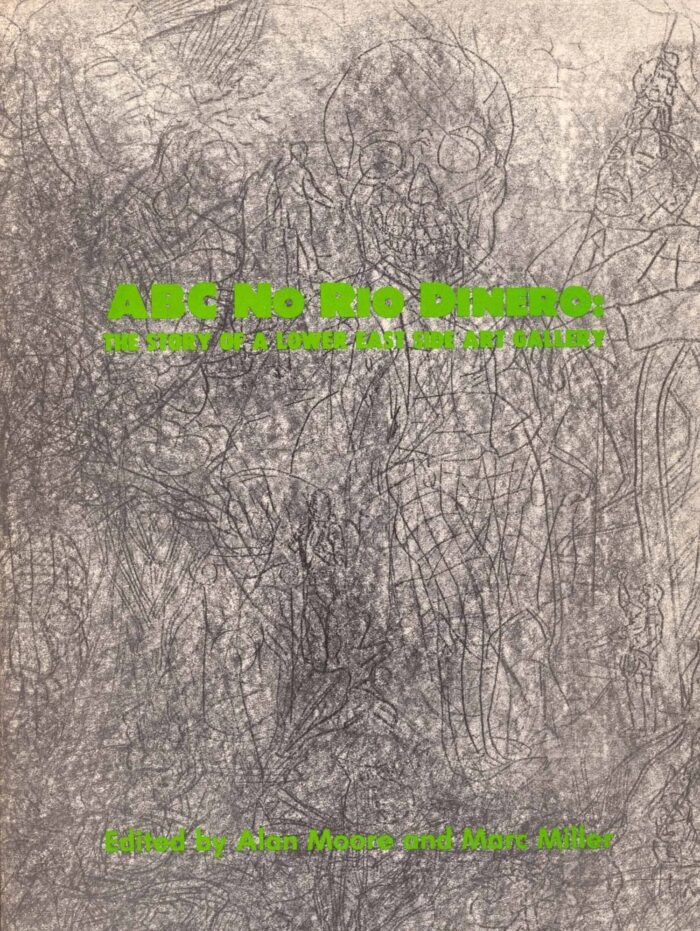
ABC No Rio Dinero: The Story of a Lower East Side Art Gallery, edited by Alan Moore and Marc Miller, over by Joseph Nechvatal, 220-Page Book, 1985. Size: 11.5 x 9 inches.
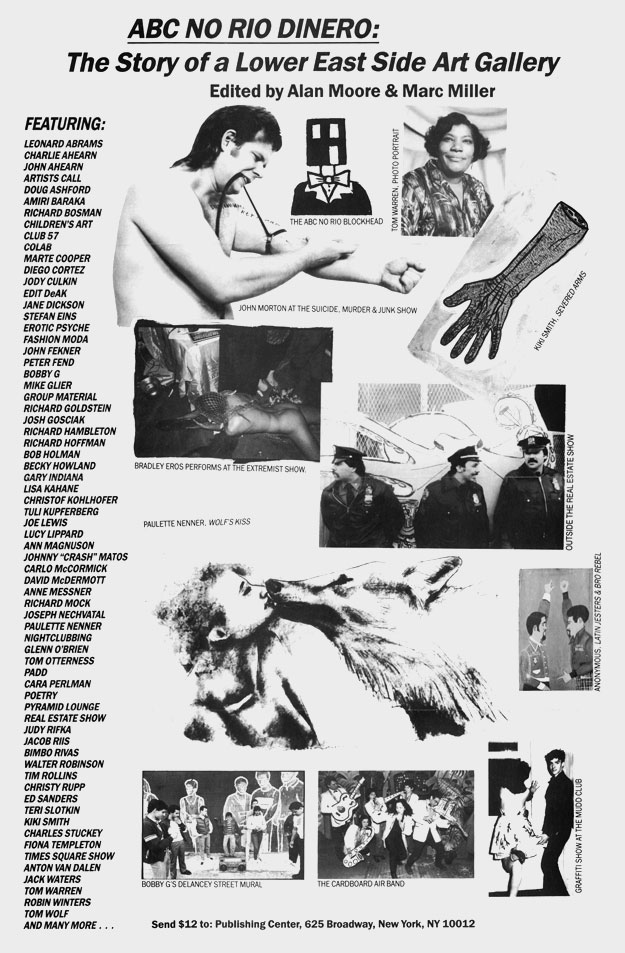
Poster for ABC No Rio Dinero: The Story of a Lower East Side Art Gallery, edited by Alan Moore and Marc Miller, 1985. Size: 18 x 14 inches.
The art space ABC No Rio grew out of the Real Estate Show, an illegal exhibition mounted in a vacant city owned building. The police quickly closed the show, but at a time when the Lower East Side had many abandoned buildings, the city offered the artists a nearby alternative. ABC No Rio found its inspiration in the diverse culture of the LES, and specialized in theme exhibitions in which any artist could participate. The book is primarily a catalogue of the gallery’s first five years, but it also tells the story of COLAB, the artist group behind the Real Estate Show, ABC No Rio, The Times Square Show, and Fashion Moda, a related art space in the South Bronx.


