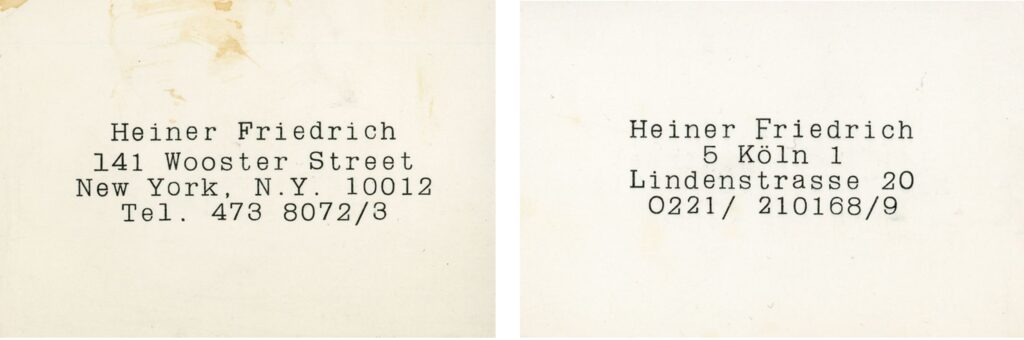
Heiner Friedrich, double-sided Business Card with addresses in New York and Köln (Germany), c. 1973. Card Size: 2 x 3 inches — Available for Purchase
Ephemera tells many stories. This week’s newsletter is about an episode of art patronage when tens of millions of dollars were spent to support and preserve works of art that did not conform to conventional categories of collecting. The story begins in 1973, when the German gallerist Heiner Friedrich moves to New York, then travels to Texas to view the Rothko Chapel, where he meets the wealthy de Menil family who had commissioned the work.
This was a period in which minimal, conceptual and land artists dreamed of creating ambitiously scaled projects that defied economic considerations. Friedrich postulated a new form of patronage where a select group of artists where given stipends, work space, and the support necessary to create and preserve monumental works and installations. Dia was established in 1974 by Friedrich, Helen Winkler, an art assistant to John and Dominque de Menil, and Philippa de Menil, the family’s youngest daughter, who largely funded the new organization’s agenda.
With money apparently being no obstacle, Dia went through $50 million in less than ten years supporting Walter de Maria, Donald Judd, Dan Flavin, John Chamberlain, and a dozen other artists. De Maria was an early beneficiary of Dia, who set up permanent spaces in Soho for his Earth Room and his Broken Kilometer, as well as, purchasing a large plot of land in New Mexico for Lightning Field. Among other projects, Dia also purchased a crater in Arizona for James Turrell, and a plot of land in Marfa Texas for Donald Judd.
The spending spree could not last, and when the price of oil (the source of the de Menil wealth), plunged in the early 1980s, Dia found itself in debt and forced to renege on many of its commitments. Friedrich left the board and Philippa’s financial support ended. A new board that included Dominque de Menil helped straighten out the financial mess, allowing Dia to move forward with a more modest budget and agenda. Today Dia continues to operate spaces in Chelsea (NYC), Beacon (NY), Bridgehampton (NY), and helps support nine sites housing specific works.
See more Dia ephemera.
John and Dominique de Menil, The Rothko Chapel, Houston (Texas), 1971-73

John Perreault, A Personal View of The Rothko Chapel and The Newman Obelisk, Pamphlet, 1972. Size: 6 x 9 inches
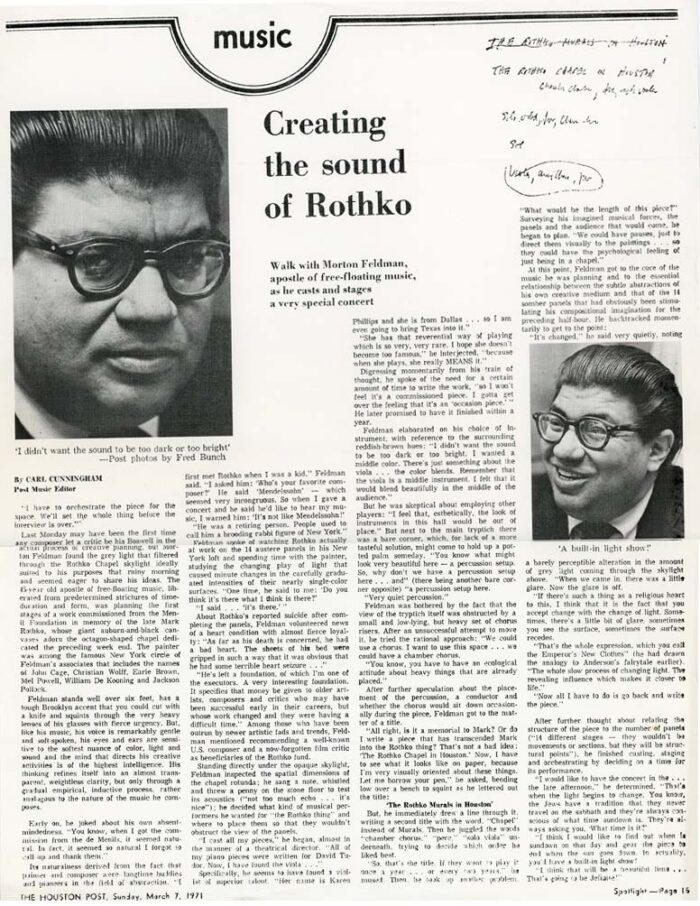
Morton Feldman, Creating the Sound of Rothko, Xerox of a press article in the Houston Post, 1971. Xerox Size: 11 x 15 inches — Available
Philippa de Menil’s family were already important art patrons when she met Heiner Friedrich and began financing Dia. Her parents John and Dominque de Menil commissioned the non-denominational Rothko Chapel (1971), housed in a building designed by Philip Johnson, featuring fourteen mural-sized paintings by Rothko. For the Chapel’s opening, the de Menils commissioned a musical score by Morton Feldman, and for its entry way, an odalisque by Barnet Newman.
Walter De Maria
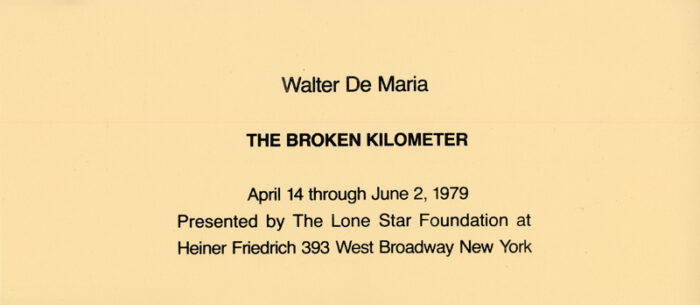
Walter De Maria, The Broken Kilometer, Presented by The Lone Star Foundation at Heiner Friedrich Gallery, Card, 1979. Card Size: 4 x 9 inches — Available

Walter De Maria, The Reopening of The New York Earth Room to be on permanent view at 141 Wooster St, Dia Art Foundation, Card, 1980. Card Size: 5 x 7 inches — Available
The Lone Star Foundation was the original name for what eventually became known as The Dia Foundation. Conceptual/land artist Walter de Maria was one of the first artists commissioned by Dia. His Broken Kilometer is a huge work made up of 500 carefully cut brass rods, whereas New York Earth Room is a large room filled with earth to the height of 22 inches. Both of these De Maria works have remained on permanent display and can still be viewed today.
Dan Flavin

Dan Flavin, Lighting the Platforms of Tracks 18-19 39-40, 41-42, Dia Art Foundation, Card, 1977. Card Size: 6 x 4 inches — Available

The Dan Flavin Art Institute (Bridgehampton), Dia Art Foundation, Folded Card, 1983. Size: 17 x 4.5 inches (Unfolded) — Available
With Dia’s help, Dan Flavin was able to greatly expand the scale of his florescent light installations. Lighting the Platforms (1977) lined three tracks at Grand Central Station and remained on view through 1987. The Dan Flavin Art Institute in Bridgehampton, N.Y., was originally intended to be a permanent museum featuring his work. While it still includes installations of some of Flavin’s work, it has recently been renamed Dia-Bridgehampton.
See more Dan Flavin ephemera
Music and Light: La Monte Young, Marian Zazeela, Pandit Pran Nath
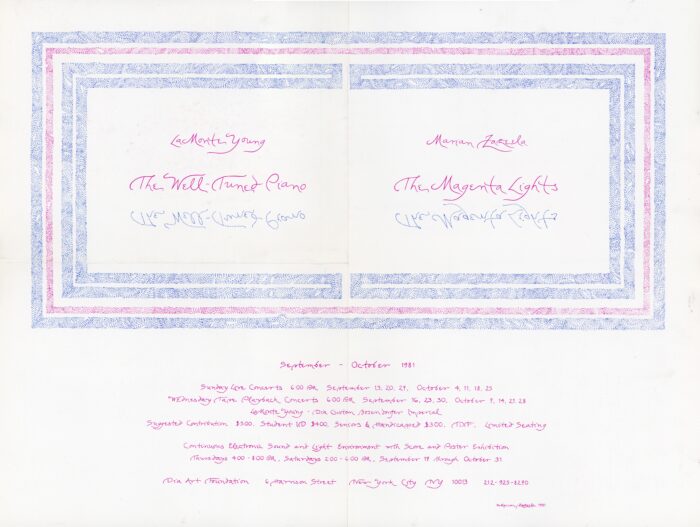
La Monte Young, The Well-Tuned Piano, Marian Zazeela, The Magenta Lights, Dia Art Foundation, Poster Design by Marian Zazeela, 1981 Poster Size: 11.25 x 14.25 Inches — Available
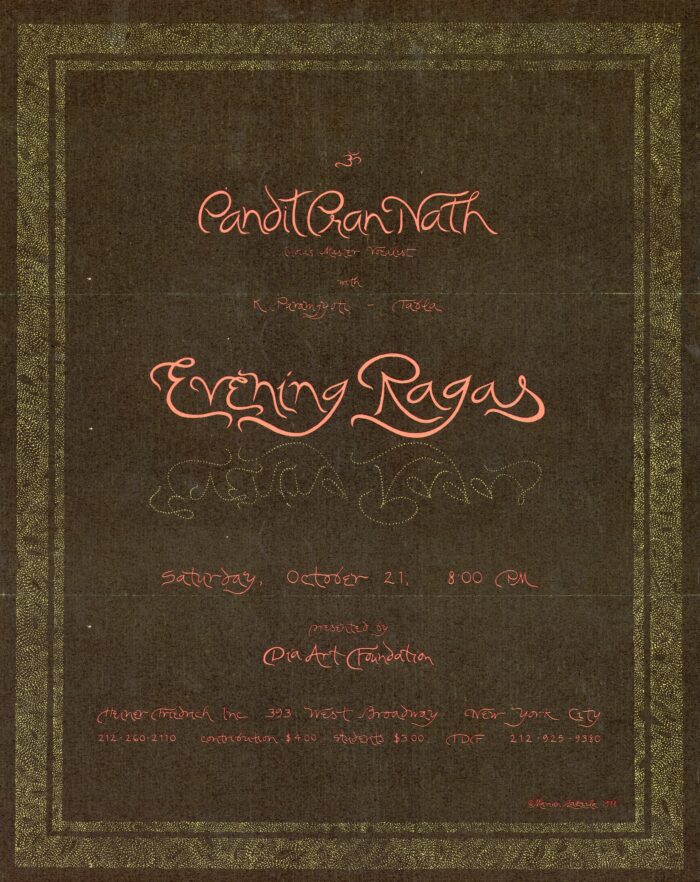
Pandit Pran Nath, Evening Ragas, Dia Art Foundation, Poster by Marian Zazeela, 1978. Size: 11 x 14 inches — Available
See more ephemera connected to Minimalism in Music
Much of the work that Dia supported had a spiritual component. This was especially the case with their musical sponsorship. Performances by the minimalist composer La Monte Young were often staged in conjunction with light installations by his wife Marian Zazeela. The two had hoped to create a permanent “Dream House,” but Dia’s financial problems prevented this from happening. La Monte Young, Heiner Friedrich and Philippa de Menil were all interested in Indian music, and staged many performances by Pandit Pran Narth, a singer and master of ragas.
Dia Center for the Arts

Joseph Beuys, Imi Knoebel, and Blinky Palermo, Inaugural Exhibition for Dia Art Foundation’s new Chelsea Space, Press Packet with 17 items, 1987. Folder Size: 9 x 12 inches — Available
In the early 1980’s, the Dia Foundation faced severe financial difficulties, which led to a restructuring of its board (Friedrich was ousted), and a down-sizing of its ambitions. One outcome was the decision to create a single museum-like space to exhibit works from their permanent collection. This press kit marked the opening in 1987 of the Dia Art Center in Chelsea (NY).
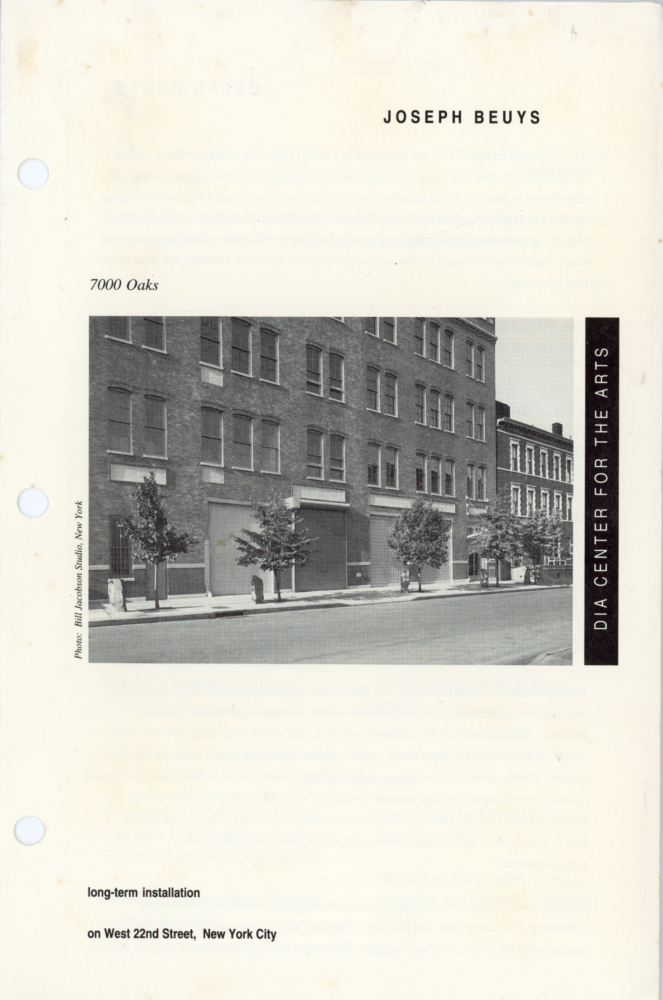
Joseph Beuys, 7,000 Oaks, Dia Center for the Arts, Pamphlet, c. 1994. Pamphlet Size: 5.5 x 8.5 inches — Available
Dia continued to commission new art on a more limited scale than previously. In 1988 they committed to participating in 7000 Oaks, an art project by Joseph Beuys to raise ecological consciousness. It called for the planting of 7,000 trees, each paired with a 4-foot-high basalt stone. This brochure celebrates the completion of five of these tree/stone plantings on West 22nd Street, and announces plans to add fifteen new trees on the opposite side of the street. This installation remains on view.
See more Joseph Beuys ephemera
An Addendum to the Earth Room: Nest

Dash Snow & Dan Colen, Nest, Deitch Projects, Folded Poster, 2007. Poster Size: 14 x 17 inches — Available
Nest, a 2007 installation at Deitch Projects in which the gallery was filled with shredded paper, brings to mind De Maria’s New York Earth Room. Nest was a collaborative work by Dan Colen and Dash Snow (1981-2009), the grandson of Marie-Christophe de Menil, one of Philippa’s sisters. A Deitch Projects press release notes how one visitor described the installation as “The New York Dirt Room.”


