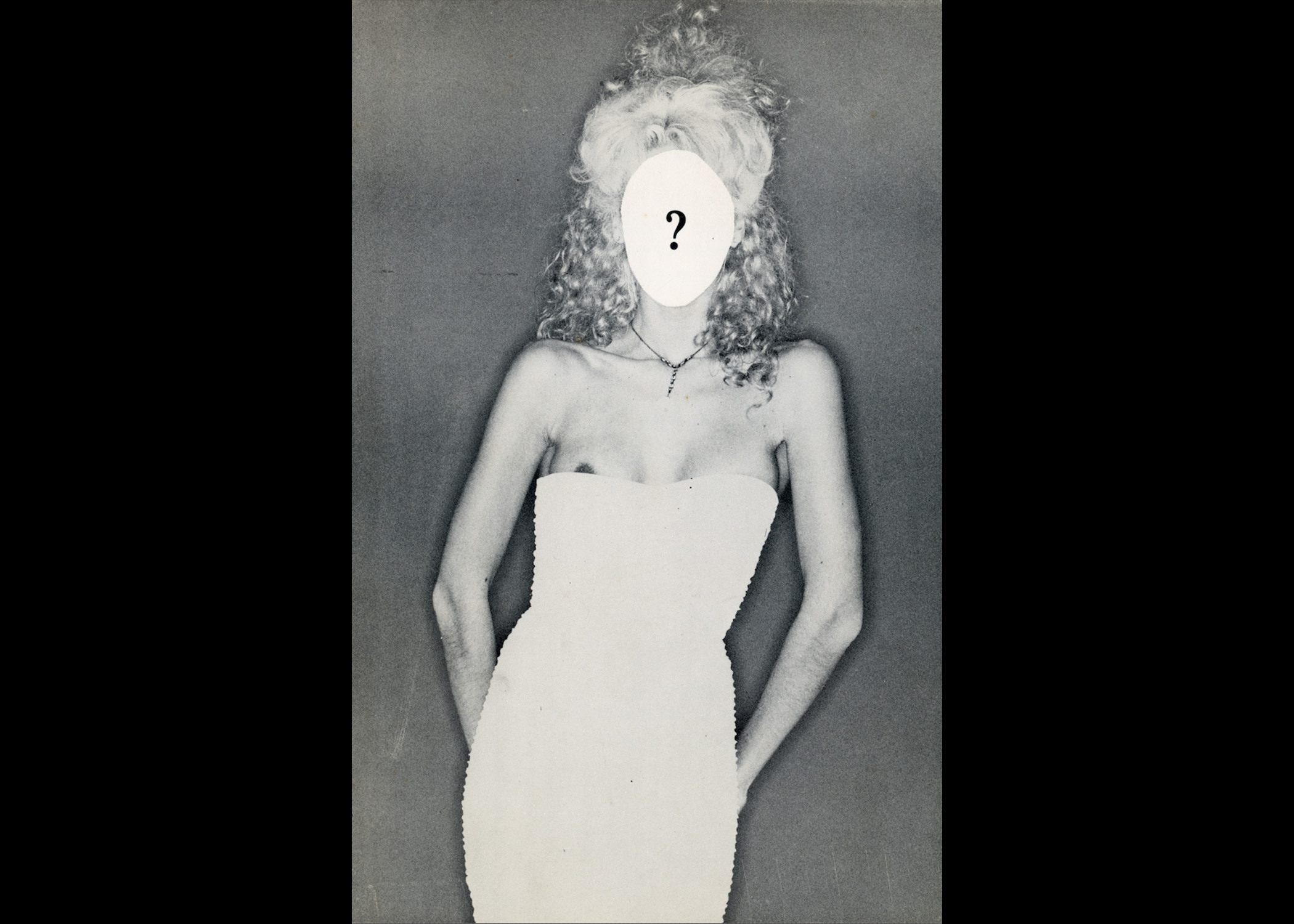
Guerrilla Girls’ Identities Exposed!, Poster, 1990. Size: 22 x 17 inches.
When the Guerrilla Girls began wheatpasting their first posters on walls in Soho and Tribeca in 1985, they introduced a provocative new type of politicized street art that had an almost immediate effect. Rooted in an era when women were increasingly conscious of widespread inequalities in America, the Guerrilla Girls spotlighted the specific plight of women in the arts. Over the next years, the Guerrilla Girls’ ongoing poster campaign called out art world powers by publicizing shockingly lopsided statistics with often sarcastic humor. The posters did not end the disparity that women artists faced, but the point was driven home, and the ratios have continued to improve.
Although they were created by an anonymous group, for primarily political purposes, a strong case can be made for the classification of the posters as fine art. Not only were all the Guerrilla Girls artists by profession, their posters were made at a time when many artists wanted to create work that effected social change. It was also a time when posters and ephemera were the key objects that documented the new temporal genres of performance and street art. Comparable to the street art posters of Jenny Holzer, Barbara Kruger, and the artist collaborative Group Material, the Guerrilla Girls posters are clever, well designed, and reflect art-world trends and concerns. Sets of these posters are now in contemporary art museums around the world. Gallery 98 has recently acquired a collection of original Guerrilla Girl posters from the 1980s.
See more Guerrilla Girls ephemera
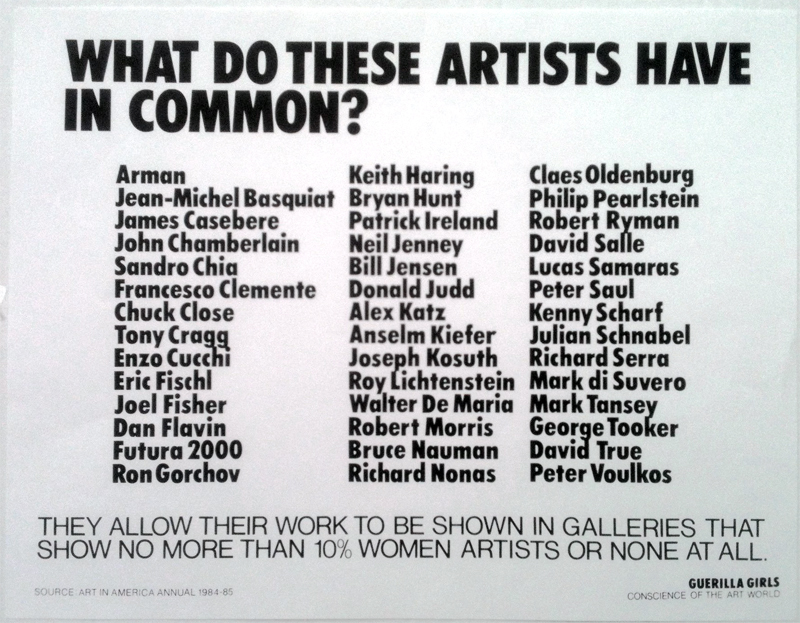
Guerrilla Girls, What Do These Artists Have in Common?, Poster, 1985. Size: 22 x 17 inches — For Sale
For their very first poster, the Guerrilla Girls surprisingly chose to list the names of famous male artists who were represented by galleries that showed less than 10% women artists. Were Jean-Michel Basquiat, Keith Haring, Claes Oldenburg, Julian Schanbel, Chuck Close, Bruce Nauman, Eric Fischl and Robert Ryman complicit, or were they potential allies in the battle against sexism in the artworld?
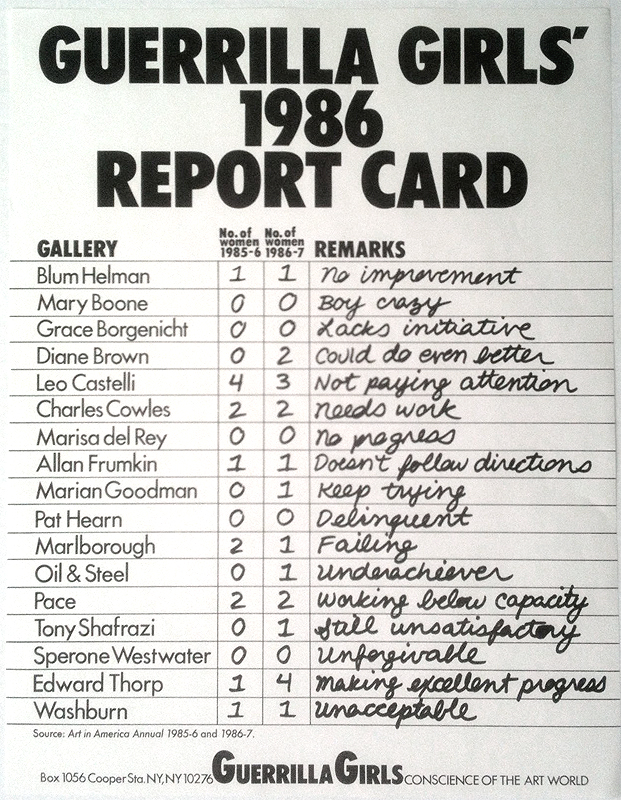
Guerrilla Girls, Guerrilla Girls’ Report Card, Poster, 1986. Size: 22 x 17 inches — For Sale
In their first two years, The Guerrilla Girls were extremely active, producing and distributing thirteen posters in 1985 and 1986. Their finger-pointing caused quite a commotion but, as this report card shows, the artworld was slow to react. Like other early Guerrilla Girl posters, it makes effective use of attention-grabbing, lopsided statistics.
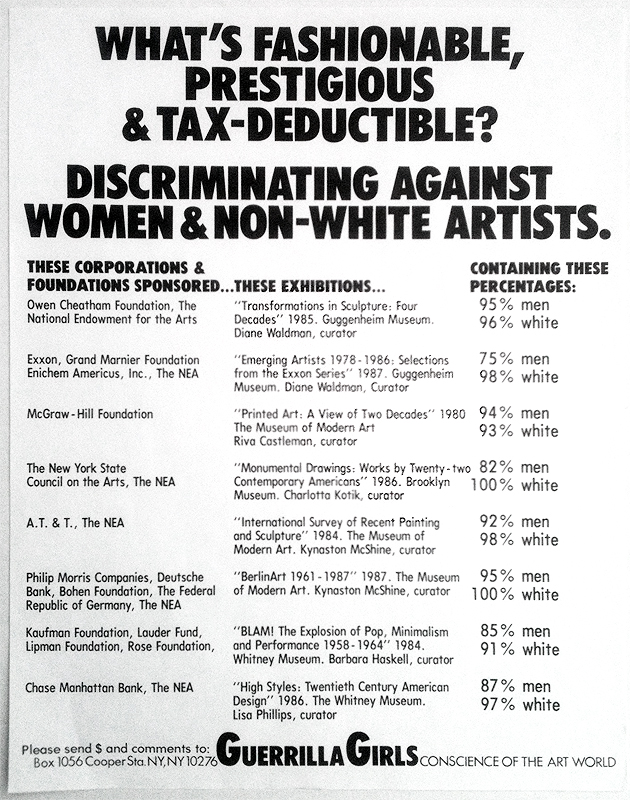
Guerrilla Girls, What’s Fashionable, Prestigious and Tax-Deductible, Poster, 1987. Size: 22 x 17 inches — For Sale
By 1987, the Guerrilla Girls were campaigning not only for women artists, but also for artists of color. Here, they call out the funders of art exhibitions like the National Endowment for the Arts, Philip Morris Companies, Chase Manhattan Bank and the Lauder Fund. They also identify culpable curators such as Kynaston McShine of MoMA, and future New Museum director Lisa Phillips, who was then still at the Whitney Museum.
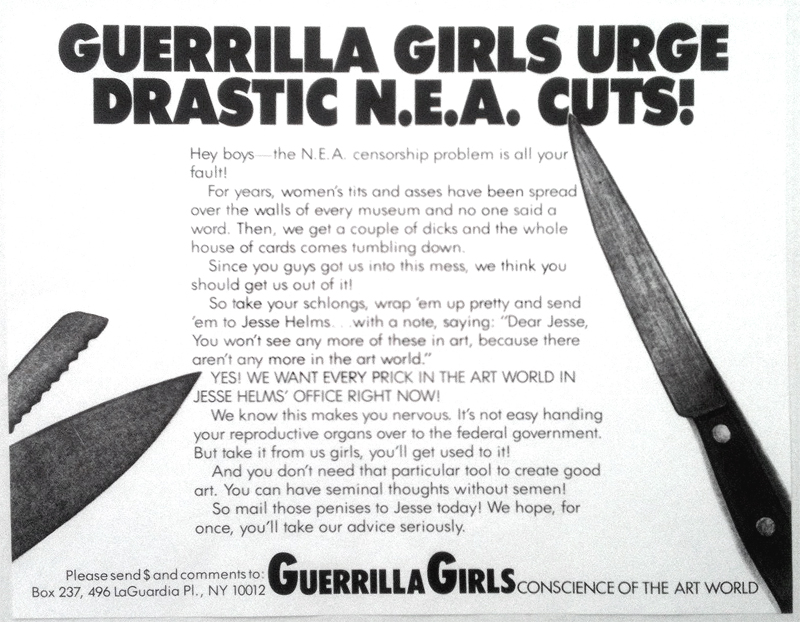
Guerrilla Girls, Guerrilla Girls Urge Drastic N.E.A. Cuts!, 1989. Size: 22 x 17 inches — For Sale
The Guerrilla Girls’ messaging expanded after July 1989, when Senator Jesse Helms introduced a legislative amendment to ban the NEA from funding art considered obscene and disrespectful to religious and other groups. For the Guerrilla Girls, it seemed ironic that works by artists like Robert Mapplethorpe could incite such a reaction. As they wrote on this poster: “For years, women’s tits and asses, have been spread over the walls of every museum and no one said a word. Then we get a couple of dicks and the whole house of cards comes tumbling down.”
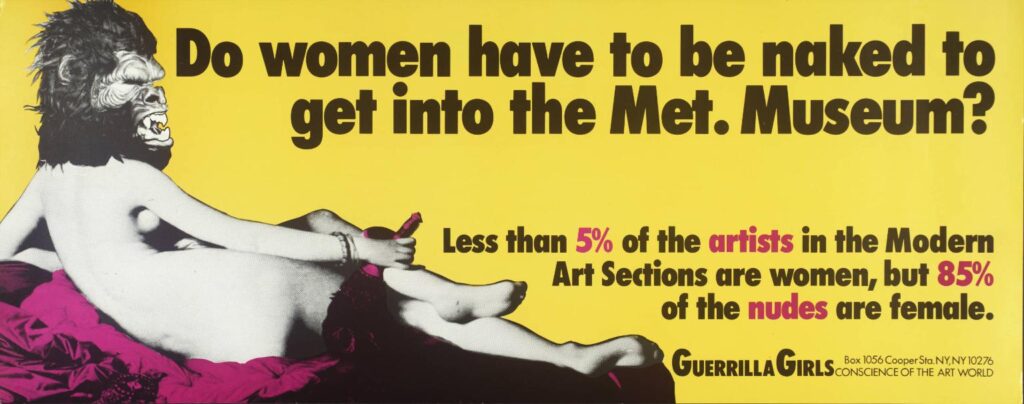
Guerrilla Girls, Do Women Have to be Naked To Get Into The Met. Museum, Poster, 1989. Size: 28 x 11 inches — For Sale
This is by far the Guerrilla Girls’ most popular poster. When the Public Art Fund refused to fund it, the Guerrilla Girls used their own funds to rent advertising space on New York City buses. Like other bus advertisements, the posters were designed to fit into the MTA’s allotted space for interior advertising, and needed to be printed on heavy cardboard. The Guerrilla Girls also printed additional posters (like this one) on the paper they regularly used for posters wheatpasted on walls.